
Presentation
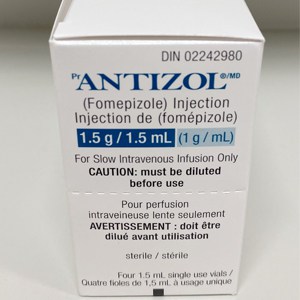
1.5g/1.5mL
Role
Management of suspected or confirmed toxic alcohol poisoning in consultation with a clinical toxicologist.
All cases of suspected toxic alcohol poisoning should be discussed with a clinical toxicologist through local toxicology service or Poisons Information Centre 13 11 26.
Dose
- Loading dose: 15mg/kg IV
- Maintenance dose:
- 10mg/kg q12h for 48h, if fomepizole is required beyond 48h the maintenance dose is 15mg/kg q12h.
- If undergoing continuous renal replacement therapy (CRRT), reduce the dosing interval to q8h.
- If undergoing intermittent haemodialysis (IHD), reduce the dosing interval to q4h.
Role
Management of suspected or confirmed toxic alcohol poisoning in consultation with a clinical toxicologist.
Precautions
- Fomepizole has a preferable side effect profile compared to ethanol.
- Headache, nausea, vomiting and a metallic taste have been rarely reported.
The melting point of fomepizole is 25°C, therefore often solid at room temperature. The solution should be liquefied by running the vial under warm water or by holding in the hand. Solidification does not affect the stability.
Stocking recommendations
| Tertiary centre | Regional centre | Rural centre | Remote centre |
|---|---|---|---|
| 2-4 vials | 1-2 vials | 0-1 vials | 0 vials |
Rationale
- Alcohol dehydrogenase (ADH) inhibition is a mainstay treatment in toxic alcohol poisoning; both ethanol and fomepizole are effective ADH inhibitors.
- When available, Fomepizole is the preferred antidote due to its significantly higher binding affinity and lack of inebriating effects.
- Irrespective of Fomepizole use, all patients with toxic alcohol poisoning will require ICU/HDU level cares. Early discussion with the Queensland Poisons Information Centre is strongly advised.
Disclaimer
Fact sheet developed by Queensland Poisons Information Centre.
This fact sheet is about the use of these antidotes in Australia, and may not apply to other countries. Children’s Health Queensland Hospital and Health Service cannot be held responsible for the accuracy of information, omissions of information, or any actions that may be taken as a consequence of reading this fact sheet.